
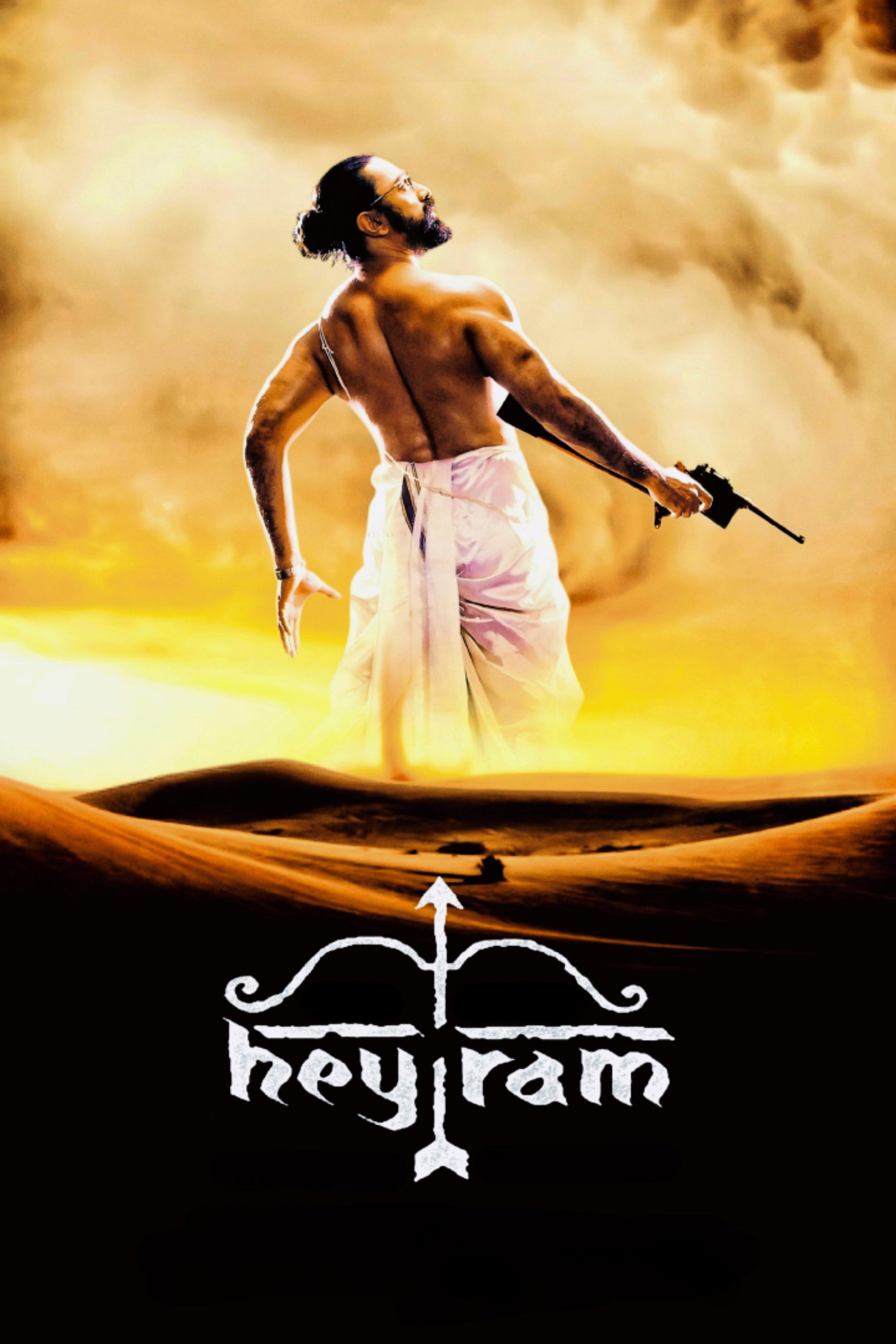
Hey Ram
Partition violence in Calcutta, the murder of Saket Ram's wife by a Muslim mob and his grief enable a recruiter to redirect personal revenge toward Gandhi. Saket becomes involved with militants and an assassination plan, then reconsiders through his relationship with Amjad and encounters with Gandhi. A frame narrative traces what that change means decades later.
Original language: Tamil
Culture Check verdict
How we rateReviewed · Not Certified
High confidence · Reviewed 2026-10-13
Not Certified, revised from Mixed. The independently adverse political-symbolic mechanism now controls the recommendation, while the real Hindu empathy and religious reconciliation remain part of the review.
Read the assessment & evidenceCultural framing · not a film-quality score
Why this verdict
Does not meet Culture Check’s civilizational certification standard · Not a film-quality score
The specific findings behind our assessment.
Not Certified, revised from Mixed. The independently adverse political-symbolic mechanism now controls the recommendation, while the real Hindu empathy and religious reconciliation remain part of the review.
The Bharatiya reading gives that repeated association independent weight. Criticizing political killing is legitimate; using Nazi-linked imagery and sacred space to define a wider nationalist moral identity is an additional narrative choice. Its effect cannot be settled only by the film’s craftsmanship or the emotional force of repentance. The film also represents Hindu suffering directly and permits Rama-associated language to carry mercy. Those features are substantial parts of the account. They prevent a careless statement that the film hates every Hindu character, but do not automatically clear its separate repeated political-symbolic association.
Noticed another scene? Tell us what happens and why it matters to Bharatiya values.
Reviewed 2026-10-13
Read our full editorial analysisWhat the film shows, its cultural framing, and why the verdict follows.
The narrative under review
Hey Ram begins from Saket Ram’s devastating loss in Calcutta violence and follows his recruitment into a plan to assassinate Gandhi. His trauma is granted sustained sympathy. The film later turns friendship, loss and Gandhi-centred reconciliation into the means through which he rejects that path.
The consequential choices
The plot places Hitler and Savarkar portraits in the same conspiratorial environment and gives a goddess shrine the function of an arsenal. These are not culturally empty props. They attach a political and sacred inheritance to the assassination network before the story repudiates it.
Our Bharatiya reading
The Bharatiya reading gives that repeated association independent weight. Criticizing political killing is legitimate; using Nazi-linked imagery and sacred space to define a wider nationalist moral identity is an additional narrative choice. Its effect cannot be settled only by the film’s craftsmanship or the emotional force of repentance.
The film also represents Hindu suffering directly and permits Rama-associated language to carry mercy. Those features are substantial parts of the account. They prevent a careless statement that the film hates every Hindu character, but do not automatically clear its separate repeated political-symbolic association.
Scope of the finding
The certification concerns the narrative arrangement, not a claim that every external historical interpretation of Partition is established by the film. Private coordination and unverified historical generalizations are not needed to identify the political-symbolic effect.
Certification
Not Certified, revised from Mixed. The independently adverse political-symbolic mechanism now controls the recommendation, while the real Hindu empathy and religious reconciliation remain part of the review.
What this review does not claim
This review uses owner-designated firsthand viewer accounts and the retained source record. No new editor screening, unverified verbatim dialogue or private filmmaker motive is claimed.
Supporting sources (4)
These sources support the analysis above. The cultural interpretation and verdict are Culture Check’s assessment.
- Owner-designated firsthand viewer — Hey Ram, feedback snapshot 13 October 2026
Supports: The narrative under review; The consequential choices; Our Bharatiya reading; Scope of the finding; Certification
- University of Iowa Indian Cinema — Hey Ram detailed scholarly film reading
Supports: The narrative under review; The consequential choices; Our Bharatiya reading; Scope of the finding; Certification
- Cornelis Rijneveld — South Asianist academic article, 2015
Supports: The narrative under review; The consequential choices; Our Bharatiya reading; Scope of the finding; Certification
- India Today — contemporary film review, February 2000
Supports: The narrative under review; The consequential choices; Our Bharatiya reading; Scope of the finding; Certification
Open the full evidence dossier
Signal map, Narrative Integrity and 7 source notes.
Open the full evidence dossier
Signal map, Narrative Integrity and 7 source notes.
Bharatiya signal map
Context for the verdict, not a film-quality score.
Dharma
3/5
Civilization
2/5
Rashtra
2/5
Itihasa
3/5
Parampara
3/5
Local Roots
3/5
Raksha
2/5
Social Dharma
3/5
Sacred Regard
2/5
Contempt Risk
3/5
Narrative Integrity
What changed, what it may mean, and what we can prove.
Evidence trail
Source notes behind this review.
review · University of Iowa Indian Cinema — Hey Ram detailed scholarly film reading
Traces Saket Ram's Calcutta trauma, Hindu nationalist recruitment, goddess-temple arsenal and Hitler/Savarkar portraits, epic Rama parallels, murder plot, later rejection and reconciliation; acknowledges critics saw both anti-Hindutva critique and overly sympathetic Hindu militants.
View sourcereview · Cornelis Rijneveld — South Asianist academic article, 2015
Argues the film does not provide sufficient critical distance from its Hindu extremist protagonist and that the Muslim friend Amjad is relatively weak and in need of Hindu paternalism; serious counter-reading against calling the film one-sided anti-Hindu propaganda.
View sourcereview · India Today — contemporary film review, February 2000
Review describes traumatic Muslim riot violence, the fictional assassin's attempted transformation and film's judgment that Gandhi's Hindu opponents were mistaken; contemporaneous source of its political and narrative balance.
View sourceinterview · Kamal Haasan — interview on Hey Ram via Indian Express, January 2023
Kamal says he wrote, directed and starred in Hey Ram to rethink his earlier criticism of Gandhi and apologise to Bapu; he explains Saket's change when nearing Gandhi, before another assassin carries out the murder.
View sourcereview · UCLA MANAS — historical argument on Gandhi's reported Hey Ram last words
Historian Vinay Lal reviews debates over Gandhi's purported last words and Gandhi's use of Ramanama and Hindu devotional language; the film's names and utterances should not be mistaken for archival proof of a disputed exact death phrase.
View sourceprimary · Owner-designated firsthand viewer — Hey Ram, feedback snapshot 13 October 2026
The viewer challenges the film’s Gandhi-centred redemption and its representation of RSS, Savarkar and Hindutva, linking a specific critical essay. These political interpretations are integrated with the existing observed scene ledger, not treated as proof of private motive.
View sourcereview · Aravindan Neelakandan — The False Symmetries of Hey Ram, Swarajya, 5 May 2017; opened 13 October 2026
The critic examines Savarkar/Hitler juxtaposition, sacred and political symbol transformations, and the redemption structure. Its external historical claims and assertions about private intentions remain separate from the film observations.
View sourceCulture Check is a declared Bharatiya cultural signal, not a film-quality rating. Facts, interpretation and claims about intent are kept separate, and factual caveats do not automatically override the certification axis.
Editorial revision history
3 recorded reviews
Open
Editorial revision history
3 recorded reviews
Review 3
2026-10-13
Reviewed · Not Certified
Not Certified, revised from Mixed. The independently adverse political-symbolic mechanism now controls the recommendation, while the real Hindu empathy and religious reconciliation remain part of the review.
Review 2
2026-10-12
Mixed / Contested
Mixed: The film strongly associates Hindu nationalist politics with assassination, Hitler portraiture and a temple arsenal; epic Hindu symbols are deployed across the path from revenge to rejection. This is a consequential political interpretation, but it also depicts targeted Hindu suffering without concealment and eventually reclaims the name of Rama for mercy and reconciliation.
Review 1
2026-10-03
Mixed / Contested
The film rejects communal hatred and ultimately reorients its protagonist toward remorse, plural belonging and moral restraint.
About the film
The film.
Partition violence in Calcutta, the murder of Saket Ram's wife by a Muslim mob and his grief enable a recruiter to redirect personal revenge toward Gandhi. Saket becomes involved with militants and an assassination plan, then reconsiders through his relationship with Amjad and encounters with Gandhi. A frame narrative traces what that change means decades later.
Keep exploring.
Return to discovery with your OTT filters and find another film.