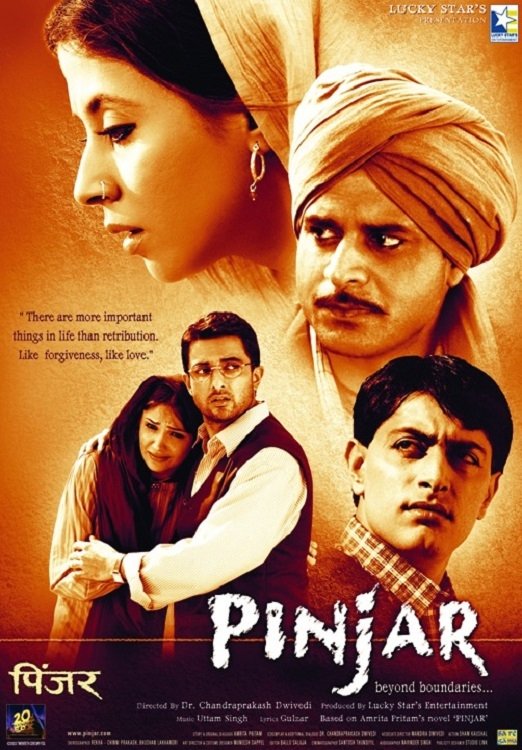
Pinjar
A Hindu woman abducted during Partition confronts violence, identity and moral choice amid communal rupture.
Original language: Hindi
Culture Check verdict
How we rateMixed / Contested
High confidence · Reviewed 2026-10-08
The film treats Partition suffering, women’s dignity, family attachment and moral responsibility with historical and civilizational seriousness.
Read the assessment & evidenceCultural framing · not a film-quality score
Why this verdict
The specific findings behind our assessment.
The film treats Partition suffering, women’s dignity, family attachment and moral responsibility with historical and civilizational seriousness.
Editorial review: Abduction, family rejection and imposed identity repeatedly burden Puro, while the opened scholarly criticism also identifies reductive Muslim visual coding and epic analogies. Rashid’s costly rescue, Ramchand’s continuing readiness to accept her and Puro’s final choice are substantial counterweight, bounding fail rather than erasing either side’s harm. Caution changes Certified to Mixed: reconciliation does not make kidnapping legitimate or supply a comprehensive Partition history. The Ravana-to-Hanuman reading is attributed interpretation, and cultural translation and the Sita song preserve internal resources without automatically cancelling cumulative gender and communal framing.
gendered-community-humiliation: Identity, honour and intimate harm are linked, but internal compassion and competing communal coding bound a definitive community-humiliation finding.
Noticed another scene? Tell us what happens and why it matters to Bharatiya values.
Reviewed 2026-10-08
Open the full evidence dossier
Signal map, Narrative Integrity and 3 source notes.
Open the full evidence dossier
Signal map, Narrative Integrity and 3 source notes.
Bharatiya signal map
Context for the verdict, not a film-quality score.
Dharma
4/5
Civilization
4/5
Rashtra
3/5
Itihasa
2/5
Parampara
4/5
Local Roots
4/5
Raksha
3/5
Social Dharma
2/5
Sacred Regard
4/5
Contempt Risk
0/5
Narrative Integrity
What changed, what it may mean, and what we can prove.
Evidence trail
Source notes behind this review.
film · Wikipedia title discovery
Title/year, credited premise and publicly documented plot context for Pinjar (2003) were checked as the baseline film record.
View sourcefilm · IMDb title discovery
Independent title/credits discovery was used to cross-check that the certification attaches to the intended 2003 film rather than a remake or namesake.
View sourcereview · title-specific opened plot or critical evidence
Opened scholarly analysis and complete plot weigh epic analogy, communal coding, coerced identity and consequential internal rescue and choice.
View sourceCulture Check is a declared Bharatiya cultural signal, not a film-quality rating. Facts, interpretation and claims about intent are kept separate, and factual caveats do not automatically override the certification axis.
Editorial revision history
2 recorded reviews
Open
Editorial revision history
2 recorded reviews
Review 2
2026-10-08
Mixed / Contested
The film treats Partition suffering, women’s dignity, family attachment and moral responsibility with historical and civilizational seriousness.
Review 1
2026-10-03
Sanghi Certified
The film treats Partition suffering, women’s dignity, family attachment and moral responsibility with historical and civilizational seriousness.
About the film
The film.
A Hindu woman abducted during Partition confronts violence, identity and moral choice amid communal rupture.
Keep exploring.
Return to discovery with your OTT filters and find another film.