
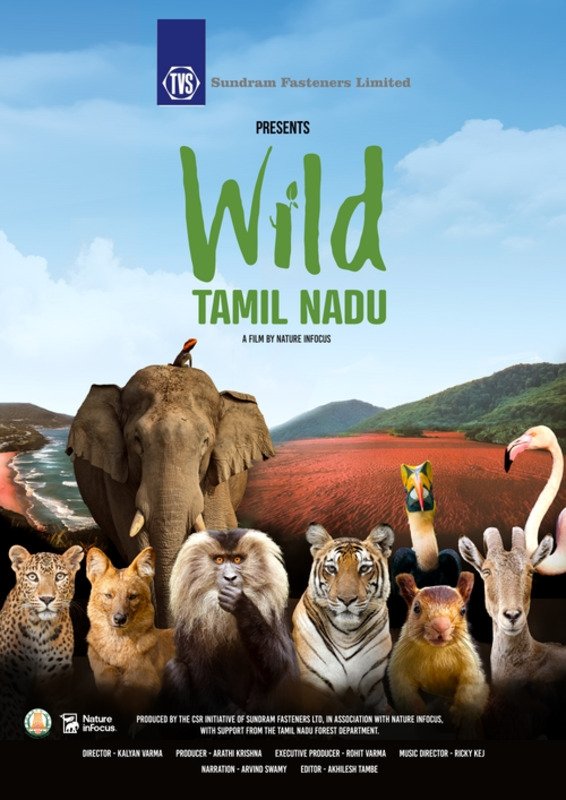
Wild Tamil Nadu
The documentary organises wildlife across Kurinji, Mullai, Marutham, Neithal and Paalai, relating ecological observation to Sangam landscape categories.
Original language: Tamil
Culture Check verdict
How we rateSanghi Certified
High confidence · Reviewed 2026-10-11
The documentary deliberately interprets Tamil Nadu’s biodiversity through the five classical landscapes of Sangam literature, joining ecological stewardship to more than two millennia of Tamil place-memory.
Read the assessment & evidenceCultural framing · not a film-quality score
Why this verdict
Called an insult. Worn as a badge.
The specific findings behind our assessment.
The documentary deliberately interprets Tamil Nadu’s biodiversity through the five classical landscapes of Sangam literature, joining ecological stewardship to more than two millennia of Tamil place-memory.
Its subject is ecological and literary rather than devotional, so certification rests on Civilizational Continuity, Local Roots, Itihasa and stewardship rather than an invented sacred claim; the adversarial sweep found no material anti-sacred ideological programme.
Noticed another scene? Tell us what happens and why it matters to Bharatiya values.
Reviewed 2026-10-11
Read our full editorial analysisWhat the film shows, its cultural framing, and why the verdict follows.
The story
Kurinji, Mullai, Marutham, Neithal and Paalai organise this wildlife documentary through Sangam landscape categories. Biodiversity is interpreted in relation to an inherited Tamil understanding of place.
What matters in the film
The classical frame matters because it supplies the organising structure rather than only a decorative quotation. Ecological observation is made part of a longer continuity of landscape memory.
Culture Check reading
Culture Check values this joining of stewardship and literary inheritance. Respect for living environments gains rooted meaning through categories used to understand those environments across generations.
The strongest opposing reading
The strongest caution is that an attractive literary frame could become superficial branding. Certification therefore rests on its reported structural role, not on the mere appearance of Sangam terminology.
Why this verdict
Certified recognises ecological care linked to civilizational continuity and local memory. Wild Tamil Nadu's account is literary and environmental rather than explicitly devotional; no additional sacred claim is needed or invented.
What this review does not claim
This analysis develops the film-specific published-source record. It does not claim independent full-film viewing, verified verbatim dialogue or knowledge of the filmmaker’s private intentions.
Supporting sources (3)
These sources support the analysis above. The cultural interpretation and verdict are Culture Check’s assessment.
- Times of India — Wild Tamil Nadu review
Supports: The story; What matters in the film; Culture Check reading; The strongest opposing reading; Why this verdict
- New Indian Express — Kalyan Varma on Wild Tamil Nadu
Supports: The story; What matters in the film; Culture Check reading; The strongest opposing reading; Why this verdict
- Indulge — Sangam landscapes and Wild Tamil Nadu
Supports: The story; What matters in the film; Culture Check reading; The strongest opposing reading; Why this verdict
Open the full evidence dossier
Signal map, Narrative Integrity and 3 source notes.
Open the full evidence dossier
Signal map, Narrative Integrity and 3 source notes.
Bharatiya signal map
Context for the verdict, not a film-quality score.
Dharma
4/5
Civilization
5/5
Rashtra
1/5
Itihasa
4/5
Parampara
4/5
Local Roots
5/5
Raksha
4/5
Social Dharma
4/5
Sacred Regard
2/5
Contempt Risk
0/5
Narrative Integrity
What changed, what it may mean, and what we can prove.
Evidence trail
Source notes behind this review.
review · Times of India — Wild Tamil Nadu review
The review says the documentary structures Tamil Nadu’s wildlife through Kurinji, Mullai, Marutham, Neithal and Paalai and explicitly traces those landscape categories to Sangam literature.
View sourceinterview · New Indian Express — Kalyan Varma on Wild Tamil Nadu
The filmmaker explains the effort to rediscover Tamil Nadu’s underrepresented biodiversity through a locally rooted landscape and ecological-memory frame.
View sourcereview · Indulge — Sangam landscapes and Wild Tamil Nadu
The article connects the documentary to Tolkappiyam and the five classical thinai as a framework linking terrain, ways of life and human emotion.
View sourceCulture Check is a declared Bharatiya cultural signal, not a film-quality rating. Facts, interpretation and claims about intent are kept separate, and factual caveats do not automatically override the certification axis.
Editorial revision history
3 recorded reviews
Open
Editorial revision history
3 recorded reviews
Review 3
2026-10-11
Sanghi Certified
The documentary deliberately interprets Tamil Nadu’s biodiversity through the five classical landscapes of Sangam literature, joining ecological stewardship to more than two millennia of Tamil place-memory.
Review 2
2026-10-07
Sanghi Certified
The documentary deliberately interprets Tamil Nadu’s biodiversity through the five classical landscapes of Sangam literature, joining ecological stewardship to more than two millennia of Tamil place-memory.
Review 1
2026-10-03
Sanghi Certified
The documentary structures the state’s habitats through five landscape categories traced to Sangam literature.
About the film
The film.
The documentary organises wildlife across Kurinji, Mullai, Marutham, Neithal and Paalai, relating ecological observation to Sangam landscape categories.
Keep exploring.
Return to discovery with your OTT filters and find another film.