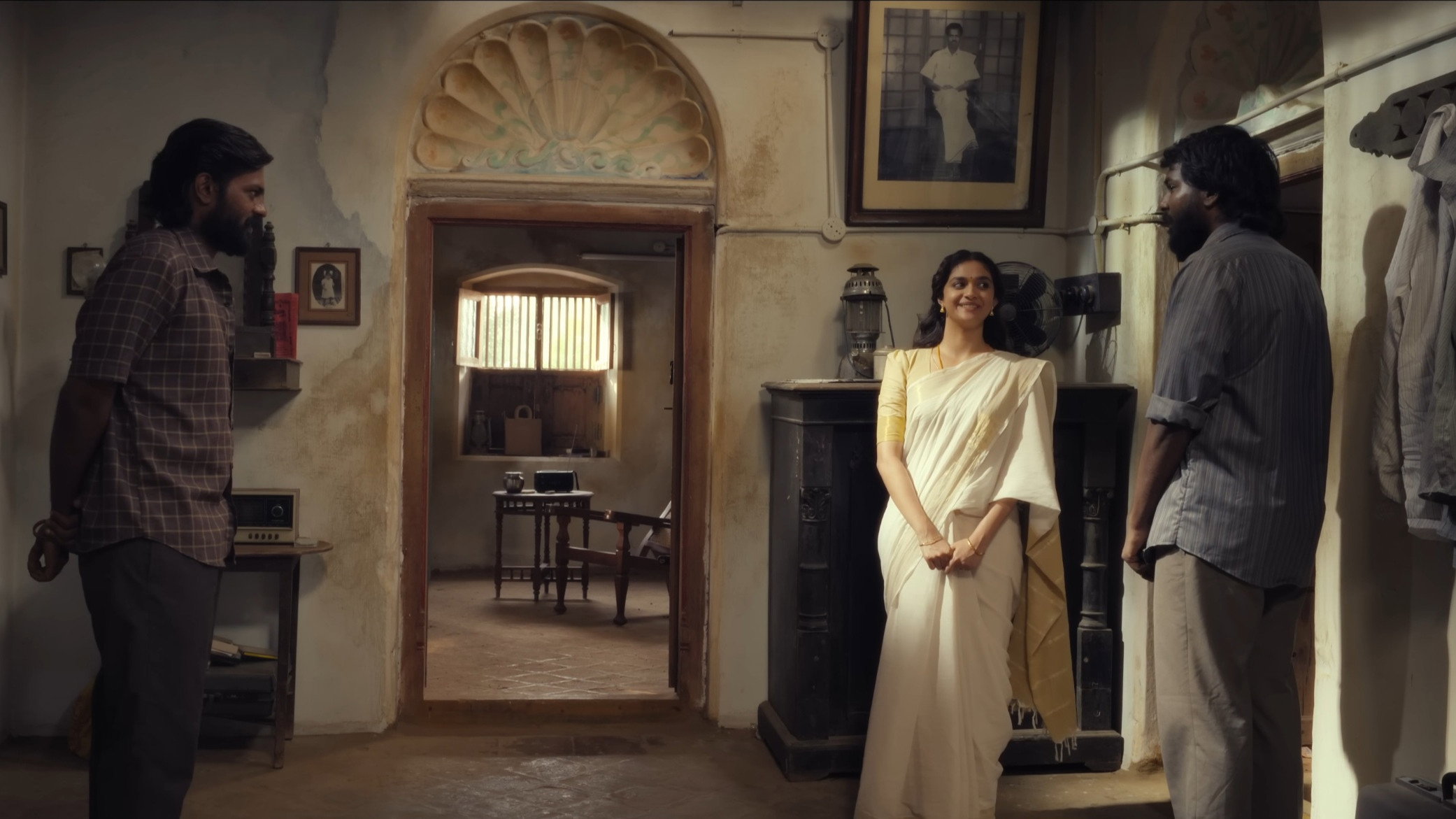

Dorothy
Subbu grows up in Veeraiya’s violent honour-oriented household; friendship with Karthi changes as they mature. Dorothy enters as Velu’s Malayali wife and becomes an emotional ally.
Original language: Tamil
Culture Check verdict
How we rateMixed / Contested
High confidence · Reviewed 2026-10-11
Dorothy has a genuine Social Dharma case: it condemns violent patriarchy, coercive family honour and cruelty toward people who do not conform, while grounding the story in rural Tamil Nadu.
Read the assessment & evidenceCultural framing · not a film-quality score
Streaming options listed for India · rental or purchase charges may apply.
Why this verdict
The specific findings behind our assessment.
Dorothy has a genuine Social Dharma case: it condemns violent patriarchy, coercive family honour and cruelty toward people who do not conform, while grounding the story in rural Tamil Nadu.
Caste and patriarchy are not incidental villain traits; multiple independent reviews describe them as central political structures in the film’s moral argument. The evidence does not establish a sufficiently strong internal Bharatiya/civilizational corrective for clean certification, while it also does not establish anti-Hindu sacred contempt.
Noticed another scene? Tell us what happens and why it matters to Bharatiya values.
Reviewed 2026-10-11
Read our full editorial analysisWhat the film shows, its cultural framing, and why the verdict follows.
The story
Subbu grows up under Veeraiya's violent honour-based authority, while her connection with Karthi changes as they mature. Dorothy, Velu's Malayali wife, enters as an emotional ally.
What matters in the film
The story's concern for people constrained by family honour has a legitimate dignity-based purpose. Subbu's vulnerability gives the critique concrete stakes beyond an abstract argument about social progress.
Culture Check reading
The qualification is that caste and violent patriarchy organise the rural moral world, rather than remaining incidental traits of one villain. The available account does not establish a comparably strong internal cultural corrective.
The strongest opposing reading
Compassion for nonconforming people can be consistent with family duty. Dorothy's name or the presence of queer attachment cannot alone establish religious comparison, and generalized sacred contempt is not documented.
Why this verdict
Mixed / Contested recognises protection against coercion while retaining the breadth of the social construction. The verdict concerns the authority and remedies the screenplay develops, rather than condemning its vulnerable characters or their choices.
What this review does not claim
This analysis develops the film-specific published-source record. It does not claim independent full-film viewing, verified verbatim dialogue or knowledge of the filmmaker’s private intentions.
Supporting sources (4)
These sources support the analysis above. The cultural interpretation and verdict are Culture Check’s assessment.
- Times of India — Dorothy review
Supports: The story; What matters in the film; Culture Check reading; The strongest opposing reading; Why this verdict
- India Today — Dorothy review
Supports: The story; What matters in the film; Culture Check reading; The strongest opposing reading; Why this verdict
- Indian Express — Dorothy review
Supports: The story; What matters in the film; Culture Check reading; The strongest opposing reading; Why this verdict
- Variety India — Dorothy review
Supports: The story; What matters in the film; Culture Check reading; The strongest opposing reading; Why this verdict
Open the full evidence dossier
Signal map, Narrative Integrity and 4 source notes.
Open the full evidence dossier
Signal map, Narrative Integrity and 4 source notes.
Bharatiya signal map
Context for the verdict, not a film-quality score.
Dharma
3/5
Civilization
2/5
Rashtra
1/5
Itihasa
1/5
Parampara
1/5
Local Roots
4/5
Raksha
3/5
Social Dharma
5/5
Sacred Regard
1/5
Contempt Risk
1/5
Narrative Integrity
What changed, what it may mean, and what we can prove.
Evidence trail
Source notes behind this review.
review · Times of India — Dorothy review
The review describes childhood friends raised inside violent patriarchy and treats that oppressive social world as the narrative problem the film confronts.
View sourcereview · India Today — Dorothy review
The review identifies Veeraiya as a patriarchal and casteist gangster driven by family pride and presents compassion and acceptance as the counter-movement.
View sourcereview · Indian Express — Dorothy review
The review explicitly characterises the film as a raw exploration of gender and caste politics whose political argument is central rather than incidental.
View sourcereview · Variety India — Dorothy review
The review describes the film as a direct challenge to patriarchy and caste and places family honour and social hierarchy at the centre of the conflict.
View sourceCulture Check is a declared Bharatiya cultural signal, not a film-quality rating. Facts, interpretation and claims about intent are kept separate, and factual caveats do not automatically override the certification axis.
Editorial revision history
3 recorded reviews
Open
Editorial revision history
3 recorded reviews
Review 3
2026-10-11
Mixed / Contested
Dorothy has a genuine Social Dharma case: it condemns violent patriarchy, coercive family honour and cruelty toward people who do not conform, while grounding the story in rural Tamil Nadu.
Review 2
2026-10-07
Mixed / Contested
Dorothy has a genuine Social Dharma case: it condemns violent patriarchy, coercive family honour and cruelty toward people who do not conform, while grounding the story in rural Tamil Nadu.
Review 1
2026-10-03
Sanghi Certified
The film explicitly frames violent patriarchy as the environment the central friends must confront as adults.
About the film
The film.
Subbu grows up in Veeraiya’s violent honour-oriented household; friendship with Karthi changes as they mature. Dorothy enters as Velu’s Malayali wife and becomes an emotional ally.
Keep exploring.
Return to discovery with your OTT filters and find another film.