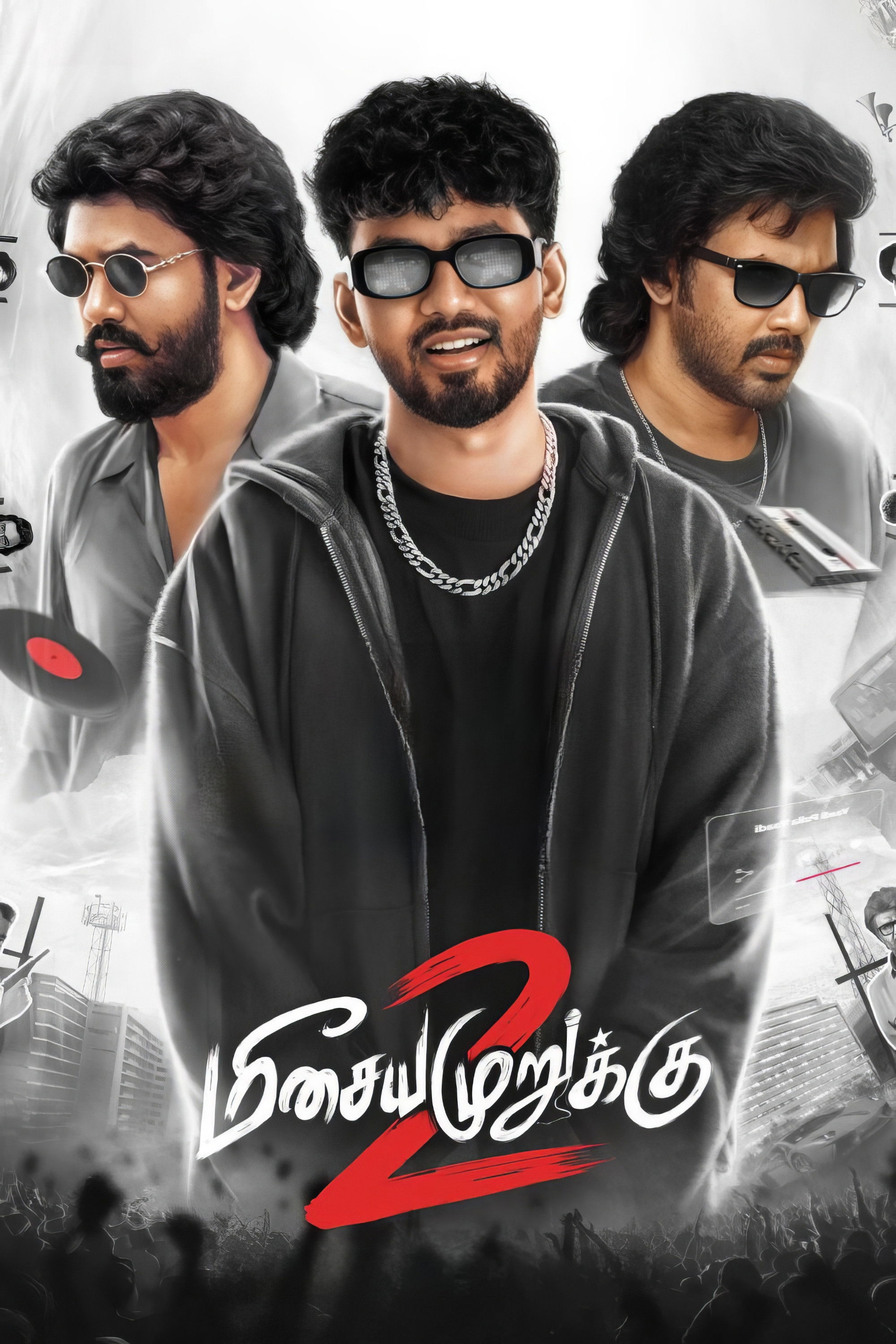
Meesaya Murukku 2
Gaana Dass, Tiger Shiva and Jeeva pursue musical recognition across three generations; Seshadri, Srini and Sanjay police their access through Carnatic-coded authority. Vaani challenges the need for that approval.
Original language: Tamil
Culture Check verdict
How we rateMixed / Contested
High confidence · Reviewed 2026-10-11
The film follows three generations of a Tamil Gaana family seeking recognition for a locally rooted musical form, giving family continuity, artistic inheritance and Local Roots substantial affirmative weight.
Read the assessment & evidenceCultural framing · not a film-quality score
Why this verdict
The specific findings behind our assessment.
The film follows three generations of a Tamil Gaana family seeking recognition for a locally rooted musical form, giving family continuity, artistic inheritance and Local Roots substantial affirmative weight.
Its caste/class critique is real, but the released film repeatedly turns Carnatic/Brahmin-coded gatekeepers into a simplified antagonist class, and independent/adversarial criticism specifically identifies the Brahmin-versus-Gaana coding as a material problem. A positive Brahmin-household character prevents a clean community-contempt finding, but the conflict is too one-sided for an unqualified Certified badge.
Noticed another scene? Tell us what happens and why it matters to Bharatiya values.
Reviewed 2026-10-11
Read our full editorial analysisWhat the film shows, its cultural framing, and why the verdict follows.
Three generations asking for a stage
Gaana Dass, Tiger Shiva and Jeeva carry a musical ambition across three generations. Cinema Express describes the family’s pursuit of recognition as repeatedly meeting Carnatic-coded gatekeepers: Seshadri, Srini and Sanjay. The conflict therefore assigns cultural identities to both the excluded artists and the people whose approval they seek.
The inheritance extends beyond music
Insightful Reels finds the family story more persuasive than the underdog campaign. Tiger Siva’s life as a bus driver gives the musical dream a practical cost: somebody must support the household when recognition fails to arrive. Jeeva’s discovery of his father’s sacrifices makes listening to an elder part of his own growth.
This is a substantial positive element. Gaana is presented as an inheritance carried through work, disappointment and affection. It deserves attention as a tradition with its own dignity, rather than being valued only because it challenges another musical tradition.
Who gets to confer legitimacy?
The concern is the repetition of a narrow moral contrast: Carnatic authority obstructs, while gaana aspiration earns sympathy. Cinema Express also questions why the later generations still need Seshadri’s approval. Our concern is that inherited musical culture becomes the recurring face of exclusion, with insufficient development of the antagonists’ individual choices.
Vaani disrupts the binary
Vaani asks why gaana needs a Carnatic exponent’s approval at all. Her support offers a different route to artistic dignity. India Today identifies Vaani as a Brahmin woman supporting gaana. She therefore complicates the community contrast from within. The family’s warmth and her agency are important counterweights to the gatekeeper pattern; the film cannot fairly be reduced to a single message about an entire community.
Why the verdict is Mixed / Contested
Mixed / Contested reflects both sides of this construction. Musical inheritance, parental sacrifice and Vaani’s challenge deserve positive weight. Repeated community-coded obstruction remains a material concern. The evidence supports that tension, rather than treating advocacy for gaana as either automatically certifiable or inherently objectionable.
What this review does not claim
Based on published criticism, with no independent full-film or lyric audit. We do not infer every Brahmin or Carnatic musician’s portrayal from the named antagonists.
Supporting sources (3)
These sources support the analysis above. The cultural interpretation and verdict are Culture Check’s assessment.
- Cinema Express — Meesaya Murukku 2 review
Supports: Three generations asking for a stage; Who gets to confer legitimacy?; Vaani disrupts the binary; Why the verdict is Mixed / Contested
- Insightful Reels — IR Desk, 26 September 2026
Supports: The inheritance extends beyond music; Vaani disrupts the binary; Why the verdict is Mixed / Contested
- India Today — Meesaya Murukku 2 review
Supports: Vaani disrupts the binary
Open the full evidence dossier
Signal map, Narrative Integrity and 5 source notes.
Open the full evidence dossier
Signal map, Narrative Integrity and 5 source notes.
Bharatiya signal map
Context for the verdict, not a film-quality score.
Dharma
4/5
Civilization
4/5
Rashtra
1/5
Itihasa
2/5
Parampara
4/5
Local Roots
5/5
Raksha
2/5
Social Dharma
4/5
Sacred Regard
1/5
Contempt Risk
2/5
Narrative Integrity
What changed, what it may mean, and what we can prove.
Evidence trail
Source notes behind this review.
review · Cinema Express — Meesaya Murukku 2 review
The review describes a three-generation Gaana struggle against Carnatic gatekeeping, calls the caste/class politics simplistic, and notes that the antagonists’ wrongdoing is largely refusal to recognise Gaana rather than broader religious or community hostility.
View sourcereview · India Today — Meesaya Murukku 2 review
The review says the film addresses caste/class barriers and Brahmin-dominated music spaces while also describing Vaani, from a Brahmin household, as supporting the proposition that both Gaana and Carnatic deserve a stage.
View sourcereview · Sudhir Srinivasan — Meesaya Murukku 2 review
The critic enjoys the satire of the powerful Brahminical Seshadri, while criticizing the treatment of Laila and LGBTQ people as punching down. He calls the system the principal villain and finds Jeeva’s eventual win too easy; these distinct judgments must not be conflated.
View sourcereview · The Commune — Meesaya Murukku 2 adversarial review
A strongly adversarial review argues that the film turns its Carnatic-versus-Gaana conflict into anti-Brahmin caricature. The source is retained as a counter-reading rather than treated as sole proof, because the same coding is independently visible in mainstream reviews.
View sourcereview · Insightful Reels — IR Desk, 26 September 2026
The review emphasises Tiger Siva’s work as a bus driver, the father-son discovery and Vaani’s agency within the family story.
View sourceCulture Check is a declared Bharatiya cultural signal, not a film-quality rating. Facts, interpretation and claims about intent are kept separate, and factual caveats do not automatically override the certification axis.
Editorial revision history
4 recorded reviews
Open
Editorial revision history
4 recorded reviews
Review 4
2026-10-11
Mixed / Contested
The film follows three generations of a Tamil Gaana family seeking recognition for a locally rooted musical form, giving family continuity, artistic inheritance and Local Roots substantial affirmative weight.
Review 3
2026-10-03
Mixed / Contested
The film follows three generations of a Tamil Gaana family seeking recognition for a locally rooted musical form, giving family continuity, artistic inheritance and Local Roots substantial affirmative weight.
Review 2
2026-10-03
Mixed / Contested
The film follows three generations of a Tamil Gaana family seeking recognition for a locally rooted musical form, giving family continuity, artistic inheritance and Local Roots substantial affirmative weight.
Review 1
2026-10-03
Sanghi Certified
The hero’s music career is explicitly tied to the unrealised dreams of two prior generations in his family.
About the film
The film.
Gaana Dass, Tiger Shiva and Jeeva pursue musical recognition across three generations; Seshadri, Srini and Sanjay police their access through Carnatic-coded authority. Vaani challenges the need for that approval.
Keep exploring.
Return to discovery with your OTT filters and find another film.